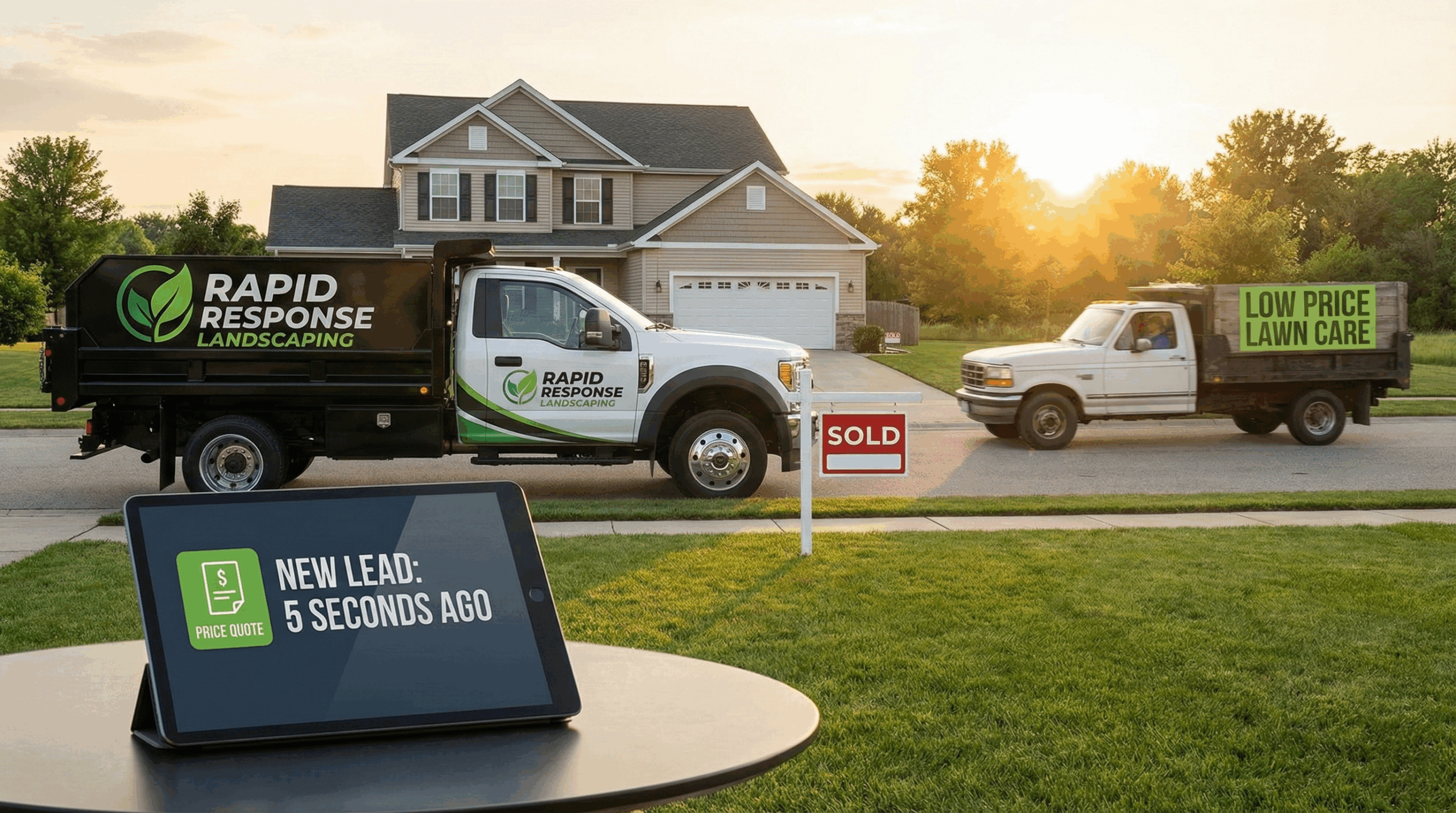


Your Leads Are Not Ignoring You. They Are Going Cold Between Touchpoints.
Why Lead Nurturing Matters More in Landscaping Than in Most Industries
Across industries, studies consistently show that a majority of qualified leads do not convert on first contact. In service businesses, it is common for most inquiries to require multiple touchpoints before a decision is made.
- Prospects reaching out during peak season but planning to move forward months later
- Property managers needing budget approval or fiscal alignment
- Homeowners comparing maintenance options over an extended period
- Commercial clients delaying decisions until the next season approaches
- Organizations evaluating ongoing maintenance agreements rather than single projects
In this environment, speed of response is only the starting point. Consistency of follow up is what determines whether a company stays visible or fades into the background. If your follow up stops after an estimate is sent, you are leaving the decision window entirely to chance.
What a Lead Nurture Sequence Should Do for TurfTraction Landscape
Clients
For TurfTraction clients, lead nurturing is not about sending more emails for the sake of activity. It is about supporting how landscape buyers actually think and make decisions.
A well built nurture sequence does four critical things.
First, it maintains visibility during slow decision periods. Landscaping decisions are often delayed rather than denied. A nurture sequence ensures your company remains present even when urgency drops.
Second, it educates prospects beyond a single job. Many prospects initially think in terms of one task. A nurture sequence reframes the conversation around long term maintenance, consistency, and planning.
Third, it builds trust before pricing becomes the central focus. When education and credibility come first, pricing discussions become more collaborative and less defensive.
Fourth, it positions your company as a planning partner. Instead of appearing as just another vendor, you are seen as a professional advisor who understands seasonal needs and long term outcomes.
The goal is not to pressure a decision. The goal is to remain relevant until the prospect is ready.
What a Lead Nurture Sequence Is and What It Is Not
Before outlining what works, it is important to clarify what a nurture sequence is not.
A nurture sequence is not:
- Repeated checking in messages with no substance
- Random newsletters sent without a clear purpose
- Aggressive sales messages disguised as follow up
- Generic communication sent the same way to every lead
These approaches create noise, not momentum.
A nurture sequence is:
- A planned series of intentional touchpoints
- Messages where each has a specific role
- Timing that matches realistic decision cycles
- Communication designed to educate, reassure, and guide
When done correctly, nurturing feels helpful rather than intrusive.
The Five to Seven Email Lead Nurture Sequence Designed for Landscaping
Below is a practical and repeatable nurture sequence aligned with landscape sales cycles and TurfTraction’s year round growth philosophy. Each email serves a defined purpose. None exist simply to fill space.
Email One: Day Zero
Purpose: Acknowledge the inquiry and set expectations
This email is sent immediately after a form submission or inbound inquiry. It confirms receipt, reinforces professionalism, and explains what happens next.
This message should:
- Thank the prospect for reaching out
- Confirm their request was received
- Clearly explain the next step
- Reinforce that your company follows a structured process
Key takeaway for the prospect:
You are in the right place, and there is a clear path forward.
Email Two: Day Three
Purpose: Educate around the real landscape problem
This email reframes the conversation away from a single task and toward long term thinking. It explains why reactive landscaping often costs more and produces inconsistent results.
Topics commonly covered include:
- The difference between reactive fixes and proactive maintenance
- How inconsistent care affects appearance and property value
- Why planning ahead reduces unexpected expenses
This is not a sales pitch. It is a shift in perspective.
Key takeaway for the prospect:
This decision affects more than just one project.
Email Three: Day Seven
Purpose: Provide proof and context
At this stage, credibility matters more than urgency. This email introduces proof through a short example or outcome focused story.
Effective approaches include:
- A brief example showing improved consistency or fewer issues
- A scenario highlighting predictability rather than speed
- A story focused on results rather than a list of services
For commercial and long term clients, stability and reliability matter more than bold claims.
Key takeaway for the prospect:
This approach works when it is applied intentionally.
Email Four: Day Fourteen
Purpose: Address budget or commitment hesitation
By this point, many prospects are thinking about cost, timing, or level of commitment. This email addresses those concerns openly without applying pressure.
This message should:
- Acknowledge budget considerations directly
- Explain phased or flexible maintenance options
- Reinforce that planning does not mean locking into a rigid agreement
The goal is to reduce hesitation, not force action.
Key takeaway for the prospect:
You can plan responsibly without overcommitting.
Email Five: Day Twenty One
Purpose: Reopen the conversation with a low pressure checkpoint
This is not a closing attempt. It is an invitation.
Rather than pushing for a commitment, the email asks a simple and low pressure question, such as whether ongoing maintenance is still being considered or whether revisiting options later would be helpful.
This gives the prospect an easy way to re engage without feeling sold to.
Key takeaway for the prospect:
If this is still relevant, there is an easy next step.
Email Six: Day Thirty and Beyond
Purpose: Transition into long term seasonal nurturing
Not every lead will convert within the first month. That does not mean the opportunity is lost.
At this stage, the lead moves into a longer term nurture track with monthly or seasonal communication.
Effective content includes:
- Seasonal maintenance insights
- Planning considerations for upcoming months
- Evaluation tips for long term property care
This keeps your company visible without chasing or pressuring.
Key takeaway for the prospect:
We will stay helpful and present when the timing makes sense.
Why This Sequence Fits Seasonal Landscape Sales Cycles
Landscape sales rarely follow a straight path. Decisions pause, restart, and shift based on weather, budgets, and operational priorities.
A structured nurture sequence ensures that:
- You remain visible when urgency drops
- You educate when prospects have time to think
- You stay top of mind when decisions resurface
Seasonal emphasis strengthens this approach.
In spring, messaging focuses on readiness and proactive planning.
In summer, the focus shifts to consistency and maintaining standards.
In fall, the conversation turns to protection and preparation.
In winter, evaluation and contract planning take center stage.
This approach works with reality rather than against it.
Why Manual Follow Up Always Breaks Down
Most landscape owners intend to follow up consistently. The issue is not effort. It is capacity.
Manual follow up competes with:
- Weather disruptions
- Crew management demands
- Job site issues
- Seasonal surges in workload
As a result, follow up becomes inconsistent. Messages are delayed. Some leads are forgotten entirely.
An automated nurture system removes reliance on memory or availability. It runs in the background, maintaining visibility regardless of daily operational pressures.
Turning Lead Nurturing Into a Permanent Growth Asset
The most effective nurture systems are not rewritten every season. They are built once, automated once, and refined over time.
This is exactly how TurfTraction’s Launch Plan approaches lead nurturing.
By automating follow up and aligning messaging with seasonal decision making, landscape companies create a growth asset that works year round without constant effort.
The system does not replace personal outreach. It supports it by ensuring no lead disappears due to silence.
Ready to Stop Losing Landscape Leads to Silence?
If you want help building and automating a lead nurture sequence designed specifically for seasonal landscape businesses:
- Start with a Free Marketing Traction Assessment
- Explore the TurfTraction Academy to see how these systems work in practice
Get started on our TurfTraction toolkit and stay present long after the first inquiry.