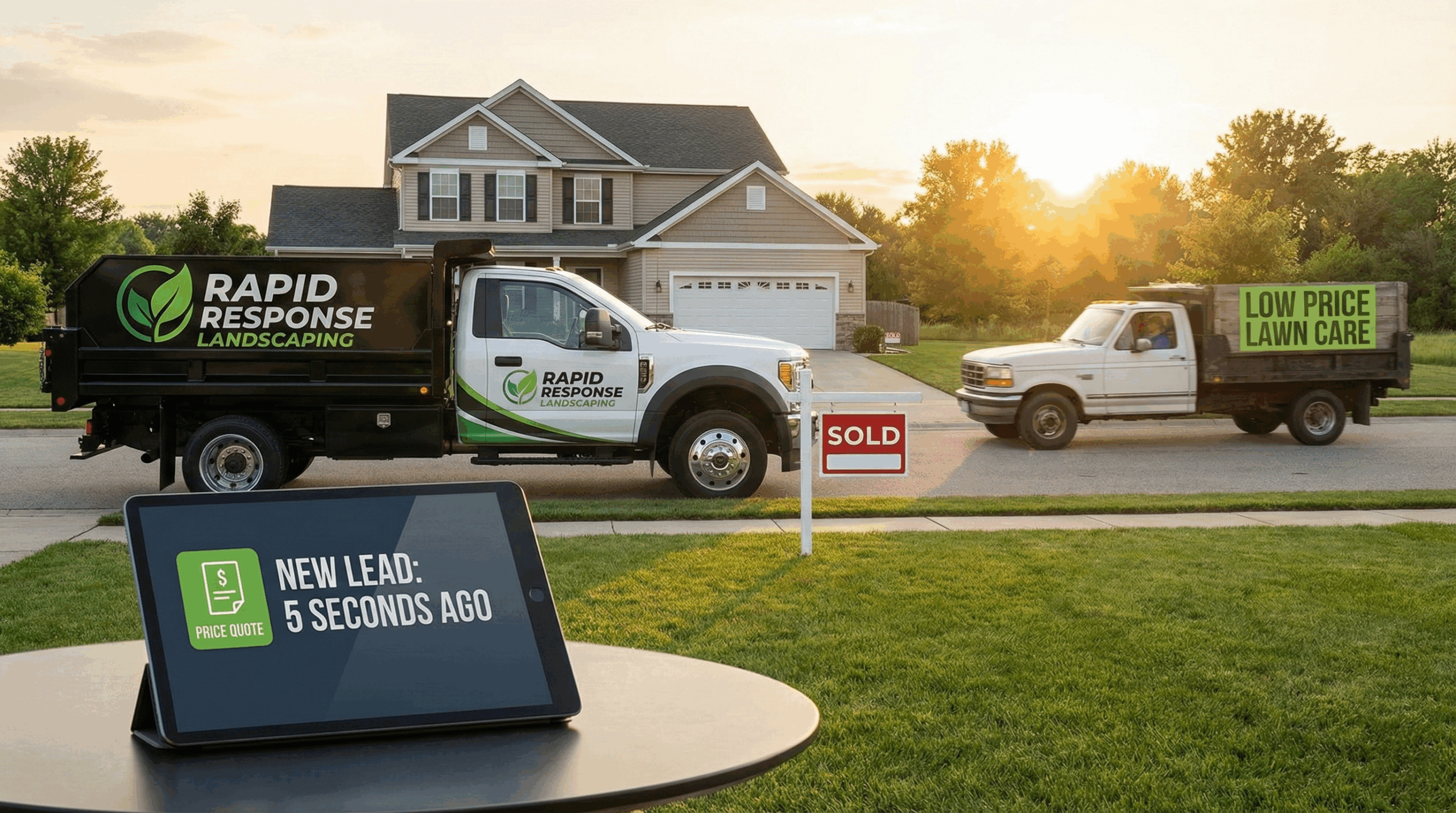


You’re Attracting Leads, But Which Ones Are Stealing Your Time?
Your landscape business is finally getting the traction you’ve worked for. The phone is ringing. The inbox is filling up. On the surface, this looks like the definition of growth. You see estimated requests for backyard renovations, calls for spring cleanups, and install projects that “just need a quick quote.”
But many landscape owners are dealing with a hidden, corrosive problem: a large portion of these leads are the wrong fit for long-term stability. While your calendar is full, your bank account doesn’t reflect the level of “busyness” you’re experiencing. Some prospects want a one-time project at the lowest possible price. Others are quietly evaluating a long-term maintenance partner who can take the weight of property management off their shoulders.
Treating those two inquiries the same keeps you busy but it doesn’t keep you profitable. The real question isn’t whether you’re getting leads. It’s how you identify which ones are actually worth the fuel in your truck and the hours of your estimator’s day.
The Real Cost of Wrong-Fit Landscape Leads
Wrong-fit leads are dangerous because they don’t look “bad” at first. They are often polite, responsive, and seem genuinely interested in your work. However, they operate on a different value system than your ideal client.
The Operational Drain
When you chase every lead, your overhead skyrockets. Operationally, wrong-fit leads tend to:
- Create significant sales inefficiency: Industry observations indicate that wrong-fit leads tend to consume a meaningful share of sales and estimating capacity, often driven by repeated quote revisions and prolonged decision cycles that do not result in signed work.
- Close at lower prices: Because they view landscaping as a commodity, they shop on price alone, forcing you into a “race to the bottom.”
- Require more follow-ups: They are indecisive because they lack a clear vision for their property.
- Deliver zero recurring revenue: Once the project is done, they disappear until the next “emergency” cleanup.
Learn more in: Automate Landscaping Leads and discover why now is the perfect time to automate your growth
The Math of Maintenance
In a landscape business, the cost of acquiring a new customer is high. If you only serve a customer once, you have to pay that acquisition cost over and over. By contrast, maintenance-oriented prospects:
- Shorten time to close: Industry observations suggest that recurring-service prospects often close materially faster than one-off project leads, driven by urgency, clearer problem definition, and solution-oriented buying behavior.
- Commit to recurring agreements: This creates “mailbox money” revenue that shows up every month without a new sales pitch.
- Outperform one-time projects on lifetime value: A client who pays $500/month for five years is worth infinitely more than a one-time $5,000 patio install that carries a high liability and low margin.
Why Landscape Companies Struggle to Qualify Leads
Most landscape businesses are built around execution, mowing, planting, and building not filtering demand. There is a “scarcity mindset” that plagues the industry: the fear that saying “no” to a $500 cleanup today means missing out on the mortgage payment tomorrow.
Common patterns of the “Unqualified” Shop:
- The “Every Lead is Gold” Fallacy: Treating a random DM the same as a referral from your best commercial client.
- The Site Visit Trap: Driving 45 minutes to a property just to realize the homeowner has a $1,000 budget for a $10,000 project.
- Avoiding the “Money Talk”: Waiting until the very end of the process to discuss the budget, fearing you’ll “scare them off.”
- Prioritizing Busyness over Profitability: Measuring success by how many quotes went out this week rather than the quality of the contracts signed.
High-performing landscape companies don’t just sell services. They protect their production schedule by qualifying before they ever turn the key in the ignition. Want to learn more? Stop wondering and check out our article: How to Make Your Landscaping Website Stand Out.
The 7 Question Lead Qualification System
You don’t need complex sales scripts. You need clear, consistent questions that reveal intent early. These questions should be asked during the initial phone call or embedded into your website’s contact form.
1. Is This a One-Time Project or Ongoing Property Care?
This is the “North Star” question. Maintenance-ready prospects usually answer clearly they are tired of looking for new contractors every season. One-time project leads often say, “Just this for now.” While you can still take project work, knowing the intent helps you prioritize the lead.
2. What Level of Ongoing Maintenance Are You Looking For?
This forces the prospect to think about the future. Maintenance prospects will talk about frequency, seasonal color, and property standards. Vague answers like “I just want it to look okay” often indicate a transactional buyer who will be the first to cancel when the economy dips.
3. What Budget Range Have You Allocated for Annual Care?
Budget clarity is the strongest predictor of fit. Maintenance clients think in monthly or seasonal investments. If a prospect refuses to give a range, they are usually “price-shopping.” By getting a range early, you can immediately disqualify those who aren’t a match for your overhead and quality standards.
4. Who Makes the Final Decision on Landscape Services?
In the world of high-end residential or HOA/Commercial work, the person calling is often not the person signing the check. If the decision-maker (a spouse, a board member, or a property manager) isn’t involved in the initial discovery, the deal will stall.
5. How Soon Do You Need a Solution in Place?
There is a difference between “Planned Urgency” and “Reactive Urgency.” Maintenance buyers plan 3–6 months ahead. Reactive buyers call because they got a fine from their HOA or they’re hosting a party this weekend. Reactive leads are high-stress and low-loyalty.
6. Are You Comparing Ongoing Maintenance Providers?
This question reveals if they are looking for a partner or a vendor. If they are comparing three top-tier providers, they value quality. If they are looking for “anyone who can show up,” they value price.
7. What Would Success Look Like Over the Next 12 Months?
This is the “vision” question. One-time buyers focus on project completion. Maintenance-minded prospects think in seasons. They want the property to look as good in November as it does in May. If they can’t articulate a 12-month vision, they likely won’t stay for a 12-month contract.
Turning Answers Into a Simple Scoring System
Asking the questions is step one. Step two is evaluating the answers objectively. Without a scoring system, your “gut feeling” will lead you back to chasing bad leads when the schedule looks a little light.
The Lead Scoring Framework
Score each of the 7 questions on a scale of 0 to 3:
- 0 Points: No alignment (e.g., “I have no budget,” “I only want one mow”).
- 1 Point: Weak or unclear fit.
- 2 Points: Partial alignment; potential for upsell.
- 3 Points: Strong maintenance indicator; “Ideal Client” profile.
Maximum Score: 21 Points
How to Act on the Score:
- 18-21 Points (The “Gold” Leads): These are your top priority. The owner or senior estimator should handle these personally. Get to the property within 24–48 hours and present a comprehensive contract.
- 11-17 Points (The “Nurture” Leads): These have potential but might be price-sensitive or undecided. Use automated email follow-ups and educational content to move them toward a decision.
- Below 10 Points (The “Low-Fit” Leads): These are transactional. If you have a gap in your schedule, quote them a premium “one-time” price. If you are busy, politely decline or refer them to a smaller contractor.
The Psychology of Saying “No”
Many landscape owners hesitate to disqualify leads because they fear “leaving money on the table.” In reality, saying “no” to a $400 one-off job is what allows you to say “yes” to a $10,000 annual maintenance contract.
When you are selective, your brand value increases. You are no longer a “guy with a mower”; you are a professional property management firm. This pricing discipline protects your crew’s morale-they would rather work on beautiful, well-maintained properties than “jungle” cleanups for ungrateful homeowners.
Using Nurture Systems to Convert Leads Later
Just because a lead isn’t ready for a maintenance contract today doesn’t mean they won’t be in six months. A one-time mulch job can be the “entry drug” to a full-service agreement if you have a system to stay in front of them.
Effective nurture systems include:
- Seasonal Newsletters: Reminding them when it’s time for aeration, overseeding, or winterization.
- Case Studies: Showing the transformation of a property over a three-year maintenance partnership.
- Automated Re-engagement: A simple “How is the yard looking?” email sent 90 days after a one-time project.
Implementation: Building the System into Your Operations
To make this stick, lead qualification cannot be a “mental checklist.” It must be a tangible part of your workflow:
- Update Your Website Form: Replace the “Message” box with a few drop-down questions based on the 7 points above.
- Train Your Intake Person: Whoever answers the phone must be the “Gatekeeper.” Their job isn’t to book an estimate; it’s to score the lead.
- CRM Integration: Use a CRM (like Jobber, LMN, or Aspire) to tag leads by their score. This allows you to filter your list and focus your sales energy where the ROI is highest.
Final Takeaway
The most stable landscape businesses in the country aren’t the ones with the most trucks; they are the ones with the most discipline. By implementing a simple 7-question qualification system, you stop being a servant to your inbox and start being the architect of your company’s growth.
Ready to Improve Lead Quality, Not Just Lead Volume?
Don’t let another “time-thief” lead into your schedule. Click here to get in contact with our team today, or explore the 7-week action plan to learn the fundamentals that drive real business growth.